
Medical Chronology for Personal Injury Cases: Example, Template and How to Build One
Learn how to build a medical chronology for a personal injury case, with a free template, a filled-in example, and tips for handling gaps and prior injuries.
On this page
- What Is a Medical Chronology?
- Why a Medical Chronology Matters in a Personal Injury Case
- Who Prepares a Medical Chronology?
- What to Include in a Medical Chronology
- How to Prepare a Medical Chronology: Step by Step
- Medical Chronology Template
- Medical Chronology Example: Rear-End Collision Case
- How to Handle Gaps in Treatment and Pre-Existing Conditions
- How to Use a Medical Chronology in Your Case
- Common Medical Chronology Mistakes
- Medical Chronology Checklist
- How CaseQube Helps Personal Injury Firms Organize Medical Records
- Frequently Asked Questions
A personal injury case can come with hundreds or thousands of pages of medical records. ER notes, imaging reports, physical therapy logs, specialist consults and bills from a dozen providers, all in different formats and rarely in order. Before anyone can write a demand or prepare for a deposition, someone has to turn that pile into a clear account of what happened.
That's the job of a medical chronology. This guide explains what a medical chronology is, what goes in one, and how to build one step by step. It includes a template you can copy and a filled-in example for a sample personal injury case.
What Is a Medical Chronology?
A medical chronology is a date-ordered summary of a client's medical treatment, with each entry tied to the page in the records it came from. It shows what treatment the client received, when, from whom, what the providers found, and where the record has gaps.
In a personal injury case, the chronology is the working document the legal team relies on. Attorneys use it to evaluate the case, paralegals use it to draft the demand, and everyone uses it to find the source page quickly when a question comes up.
Medical Chronology vs. Medical Summary
The two are related but different.
- Medical chronology: organized by date. It answers "what happened, and when?" Each entry is a single visit or event.
- Medical summary: organized by topic, such as injury, body part or provider. It answers "what does it all mean?" and is often written as a narrative.
Most firms build the chronology first, then write the summary from it. The summary often becomes the medical section of the demand letter.
Why a Medical Chronology Matters in a Personal Injury Case
A good medical chronology helps your team:
- Show causation: connect the accident to the first complaint, the diagnosis and the treatment that followed
- Prove damages: list every visit, procedure and charge so the medical specials are complete
- Spot weak points early: find gaps in treatment, missed appointments and prior injuries before the defense does
- Draft faster: pull facts and page cites straight into the demand letter, discovery responses and deposition outlines
- Answer questions quickly: when an adjuster or opposing counsel asks about a visit, the source page is one lookup away
Who Prepares a Medical Chronology?
In most personal injury firms, a paralegal or case manager prepares the medical chronology and an attorney reviews it. Firms with complex medical cases sometimes use a legal nurse consultant, who can read clinical notes more quickly and catch medical issues a non-clinician might miss. High-volume firms sometimes outsource chronologies to a record review service.
Whoever builds it, the attorney should review it before it's used in a demand or shared outside the firm.
What to Include in a Medical Chronology
Every medical chronology has two parts: a header with case details, and a table of entries.
Header:
- Client name and date of birth
- Date of incident and how it happened
- Claimed injuries
- Providers whose records are included
- Records received through (date)
- Prepared by, reviewed by and version number
Each entry:
- Date of service
- Provider and facility
- Visit type (ER, PCP, PT, imaging, specialist, surgery)
- Complaints and findings, including pain scores
- Diagnosis
- Treatment and plan, including referrals and restrictions
- Charges
- Source page or Bates number
- Flag for anything the attorney should notice (gap, prior injury, inconsistency, future care)
How to Prepare a Medical Chronology: Step by Step
Step 1: Request All Medical Records and Bills
Start with the client interview. List every provider the client saw after the accident, plus any provider who treated the same body parts in the years before. Then request both records and itemized bills from each one.
Records requests are often the slowest part of the process. Under HIPAA, when a patient requests their own records, a provider generally has 30 days to respond and can take one 30-day extension, according to the HHS guidance on individuals' right to access their health information. Track each request with a date and follow up before the deadline passes.
Step 2: Index, Bates-Number and Remove Duplicates
Before you write a single entry, organize the records. Combine them into one set, run OCR so scanned pages are searchable, add Bates numbers, and remove duplicate pages. Many providers send the same notes more than once. Bates numbers give every page a permanent cite, so anyone can find the source later.
Step 3: Sort Records by Date of Service
Put every record in order by the date the care happened, not the date you received it. When one document covers several dates, such as a PT log, either break it into separate entries or use a date range.
Step 4: Pull the Key Facts From Each Visit
For each visit, record the complaints, exam findings, diagnoses, tests and treatment plan. Keep each entry short, usually two to four sentences. Use the provider's own words for important findings, especially anything about causation, such as "consistent with the reported motor vehicle collision." Write neutrally. The chronology records what the records say. Arguments belong in the demand.
Step 5: Document Gaps and Missing Records
Look for two kinds of gaps:
- Gaps in treatment: stretches of time when the client didn't see any provider
- Gaps in the records: visits you know happened but don't have notes for
Log both. For treatment gaps, note the length and any reason the client gave. For missing records, note what's missing and when you re-requested it.
Step 6: Flag Pre-Existing Conditions and Prior Injuries
If the client had prior complaints involving the same body part, include them in a separate prior history section. Note whether the earlier problem had resolved before the accident. Hiding prior injuries doesn't work, because the defense will find them. Documenting them lets your attorney address them directly.
Step 7: Add Charges to Each Entry
Pull the billed amount for each visit from the itemized bills and add a total at the bottom. This makes the chronology double as a medical specials summary for the demand. Note any balance that a lien or health insurer paid, since that affects settlement distribution later.
Step 8: Review, Then Update as New Records Come In
Have a second person check each entry against the source page. Then treat the chronology as a living document. Add new records as they arrive, update the "records received through" date, and change the version number so everyone knows which copy is current.
Medical Chronology Template
Copy this template into a spreadsheet or document and fill in one row per visit.
Header
- Client:
- Date of birth:
- Date of incident:
- Incident description:
- Claimed injuries:
- Records received through:
- Prepared by / Reviewed by:
- Version:
Treatment chronology
| # | Date of Service | Provider / Facility | Visit Type | Complaints and Findings | Diagnosis | Treatment / Plan | Charges | Source (Bates) | Flag |
|---|---|---|---|---|---|---|---|---|---|
| 1 | |||||||||
| 2 | |||||||||
| 3 |
Gaps and missing records log
| Type | Dates | Details | Action Taken |
|---|---|---|---|
Prior medical history
| Date | Provider | Complaint / Diagnosis | Resolved Before Incident? | Source (Bates) |
|---|---|---|---|---|
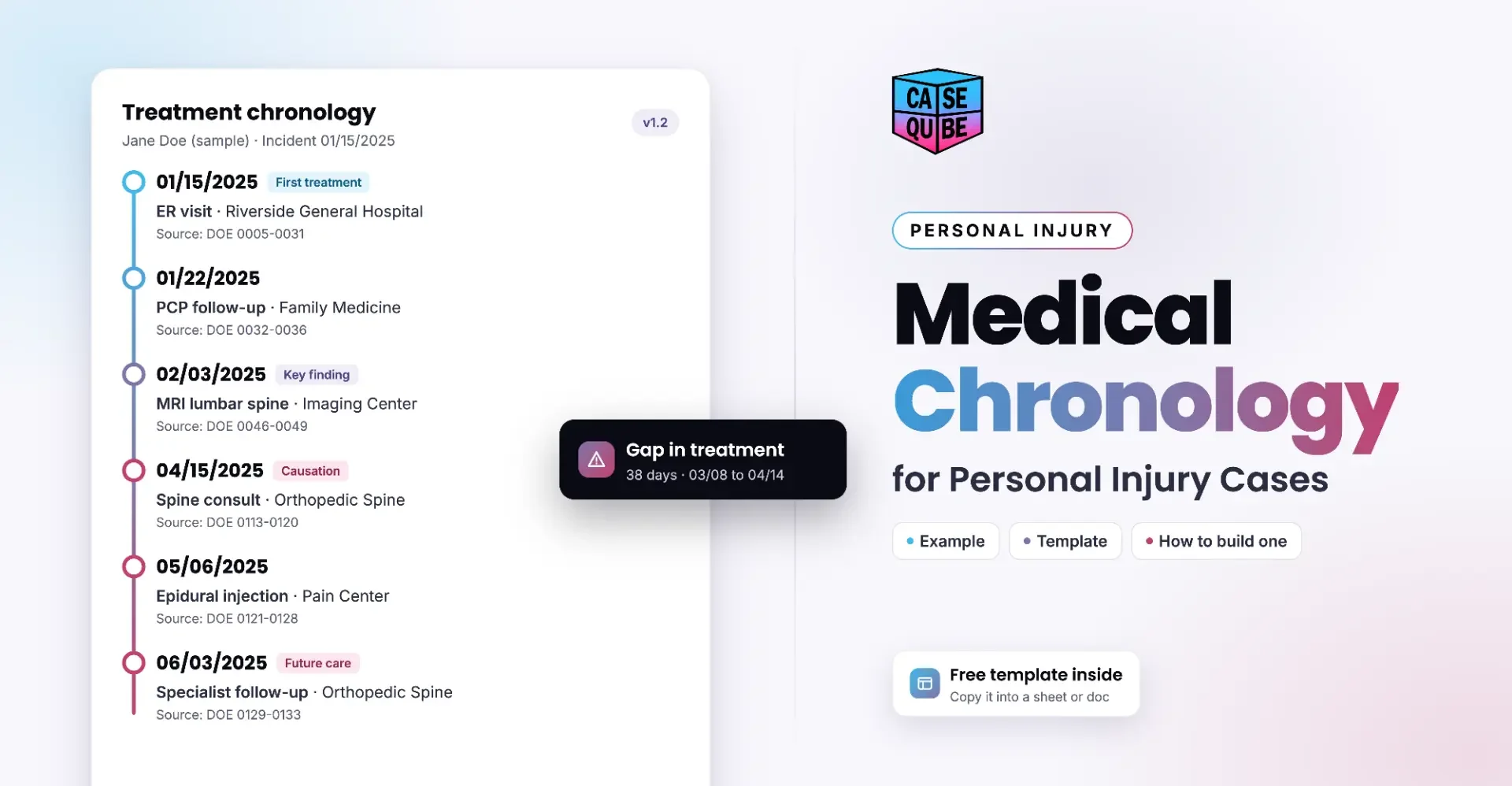
Medical Chronology Example: Rear-End Collision Case
Here's the template filled in for a sample case. All names, providers and amounts are fictional.
Header
- Client: Jane Doe (sample)
- Date of birth: 04/12/1984
- Date of incident: 01/15/2025
- Incident description: Rear-ended while stopped at a red light
- Claimed injuries: cervical strain, L4-L5 disc herniation with left leg radiculopathy, right shoulder sprain
- Records received through: 06/30/2025
- Prepared by: Paralegal / Reviewed by: Attorney
- Version: 1.2
Treatment chronology
| # | Date of Service | Provider / Facility | Visit Type | Complaints and Findings | Diagnosis | Treatment / Plan | Charges | Source (Bates) | Flag |
|---|---|---|---|---|---|---|---|---|---|
| 1 | 01/15/2025 | County EMS | Ambulance | Neck pain 6/10, low back pain. Alert, no loss of consciousness. | None given | Cervical collar, transport to ER | $1,450 | DOE 0001-0004 | |
| 2 | 01/15/2025 | Riverside General Hospital, ER | ER visit | Neck, low back and right shoulder pain. Tenderness at C5-C7. | Cervical strain, lumbar strain, right shoulder sprain | CT cervical spine negative for fracture. Muscle relaxant prescribed. Follow up with PCP. | $4,820 | DOE 0005-0031 | First treatment, same day as incident |
| 3 | 01/22/2025 | Dr. Alan Brooks, Family Medicine | PCP follow-up | Low back pain 7/10, now radiating to left leg. | Suspected lumbar radiculopathy | Referred to PT and for lumbar MRI | $210 | DOE 0032-0036 | |
| 4 | 01/28/2025 | Northside Physical Therapy | PT evaluation | Reduced lumbar range of motion, difficulty sitting over 20 minutes. | None given | PT 3x per week for 6 weeks | $340 | DOE 0037-0045 | |
| 5 | 01/30/2025 to 03/07/2025 | Northside Physical Therapy | PT visits (16 of 18 attended) | Neck improving. Low back and leg pain unchanged. | None given | Continued PT | $2,560 | DOE 0050-0112 | 2 missed visits |
| 6 | 02/03/2025 | Valley Imaging Center | MRI lumbar spine | Not applicable | L4-L5 disc herniation with left foraminal narrowing | Report sent to PCP | $1,900 | DOE 0046-0049 | Key objective finding |
| 7 | 04/15/2025 | Dr. Priya Raman, Orthopedic Spine | Specialist consult | Low back pain 7/10 radiating to left leg. Positive straight leg raise on left. Notes symptoms "consistent with the reported motor vehicle collision." | L4-L5 herniation with radiculopathy | Recommended lumbar epidural steroid injection | $450 | DOE 0113-0120 | Causation statement. Follows treatment gap. |
| 8 | 05/06/2025 | Summit Pain Center | Epidural steroid injection, L4-L5 | Pain 7/10 before, 3/10 after procedure. | L4-L5 herniation | Injection performed | $3,200 | DOE 0121-0128 | |
| 9 | 06/03/2025 | Dr. Priya Raman, Orthopedic Spine | Specialist follow-up | Pain returned to 6/10 three weeks after injection. | L4-L5 herniation with radiculopathy | Discussed microdiscectomy as an option. Client considering. | $250 | DOE 0129-0133 | Possible future surgery |
| Total | $15,180 |
Gaps and missing records log
| Type | Dates | Details | Action Taken |
|---|---|---|---|
| Gap in treatment | 03/08/2025 to 04/14/2025 (38 days) | No treatment between end of PT and spine consult. Client says the spine referral needed insurance approval. | Request referral and approval records from PCP and health insurer |
| Missing record | 02/14/2025 | PT log shows a visit, but no treatment note received | Re-requested from Northside PT on 07/01/2025 |
| Missing record | 01/15/2025 | ER CT images not included, report only | Requested images on 07/01/2025 |
Prior medical history
| Date | Provider | Complaint / Diagnosis | Resolved Before Incident? | Source (Bates) |
|---|---|---|---|---|
| 08/2021 | Dr. Alan Brooks, Family Medicine | Low back pain after lifting. Lumbar strain. | Yes. Notes show it resolved within 3 weeks, with no further back complaints until the incident. | DOE 0140-0142 |
This example shows what makes a chronology useful: every entry has a page cite, the causation statement is quoted, the treatment gap has an explanation and a next step, and the prior back strain is documented instead of ignored.
How to Handle Gaps in Treatment and Pre-Existing Conditions
These are the two issues insurance adjusters and defense attorneys look for first.
Gaps in treatment. A long stretch without care can be used to argue the client recovered, or that a later injury caused the ongoing pain. Record every gap, note its length, and find out why it happened. Common reasons include insurance approval delays, transportation problems, work schedules or waiting for a specialist appointment. Then back up the reason with documents, such as referral or authorization records.
Pre-existing conditions. A prior injury doesn't sink a case. What matters is whether the condition had resolved and whether the accident made it worse. Document the prior complaint, the date it was last treated, and any record showing it had resolved. Look for objective changes, like a new MRI finding that didn't appear on older imaging.
How to Use a Medical Chronology in Your Case
Demand letter. The chronology gives you the treatment story, the causation statements and the medical specials in one place. Our guide to writing a personal injury demand letter covers how to turn it into a demand that gets a response.
Depositions. Use the chronology to build outlines for the client, treating physicians and defense medical examiners. Page cites let you pull the exact record during questioning.
Expert review. Treating doctors and medical experts can review the chronology to get up to speed before giving an opinion.
Settlement. The charges column and lien notes feed the settlement statement. Our post on how personal injury settlements are distributed explains how fees, costs and liens come out of the gross settlement.
Common Medical Chronology Mistakes
Sorting by date received instead of date of service. The timeline stops making sense.
Leaving out page cites. An entry without a source can't be checked or used.
Copying whole notes. Long entries hide the facts that matter. Summarize.
Adding opinions. Words like "clearly caused by the accident" belong in the demand, not the chronology.
Ignoring prior records. The defense will find them. Document them first.
Skipping imaging and test results. Objective findings are often the strongest evidence of injury.
Mixing date formats. Pick one format and use it everywhere.
Not updating it. A chronology that stops at the first batch of records is out of date by the time you draft the demand.
Medical Chronology Checklist
Before the chronology goes to the attorney, check that:
- All providers from the client interview have records requested and logged
- Records are Bates-numbered and duplicates removed
- Entries are in order by date of service
- Every entry has a source page
- Diagnoses and imaging results are included
- Causation statements are quoted word for word
- Gaps in treatment are logged with length and reason
- Missing records are logged with a re-request date
- Prior history for the same body parts is documented
- Charges are added and totaled
- Header shows "records received through" date and version number
- A second person has checked entries against the source pages
How CaseQube Helps Personal Injury Firms Organize Medical Records
A medical chronology is only as good as the records behind it. CaseQube is case management software for personal injury firms, built on Salesforce, that keeps those records organized by matter:
- Matter folders: every matter gets ready-made folders, including Client Docs and Supporting Docs, so records don't get scattered across email and shared drives.
- AI document handling: CaseQube uses OCR to read scanned and uploaded files, and AI to classify, tag and file them.
- Review tools: preview and annotate documents inside CaseQube, keep earlier versions on record, and merge files into one bundle to download.
- Client uploads: clients can upload documents through a secure client portal during intake.
- Tasks and deadlines: tasks and deadlines are created automatically by case type and stage, so follow-ups on records requests have an owner.
- Settlements: track medical liens and reductions, calculate fees, and generate settlement statements.
For a broader look at software for PI firms, see our guide to the best personal injury practice management software.
See how CaseQube organizes medical records for a real matter.
Schedule a demoFrequently Asked Questions
What is a medical chronology in a personal injury case?
A medical chronology is a date-ordered summary of the client's treatment after an injury. Each entry lists the date, provider, findings, diagnosis, treatment and the source page in the records. Legal teams use it to show causation, prove damages and draft the demand.
Who prepares a medical chronology?
In most personal injury firms, a paralegal or case manager prepares it and an attorney reviews it. Firms with complex medical cases sometimes use a legal nurse consultant, and some high-volume firms outsource chronologies to a record review service.
What should be included in a medical chronology?
A header with client and incident details, then one entry per visit with the date of service, provider, visit type, complaints and findings, diagnosis, treatment plan, charges, source page and any flags. Add a log of treatment gaps and missing records, plus prior medical history.
How long does it take to prepare a medical chronology?
It depends on how many records there are and how organized they are. A simple soft tissue case with a few providers takes much less time than a surgery case with years of treatment. Waiting for records from providers often takes longer than writing the chronology.
What is the difference between a medical chronology and a medical summary?
A medical chronology is organized by date and lists each visit in order. A medical summary is organized by topic, such as injury or body part, and explains what the treatment means. Most firms build the chronology first and write the summary from it.
How do you handle gaps in medical treatment in a chronology?
Log every gap with its start date, end date and length. Ask the client why it happened and find records that support the reason, such as insurance authorization delays or referral wait times. Don't leave gaps out, because the defense will find them.
Should pre-existing conditions be included in a medical chronology?
Yes. Include prior treatment for the same body parts in a separate prior history section. Note whether the condition had resolved before the incident and any new findings after it. This lets the attorney address the issue before the defense raises it.
Is a medical chronology admissible in court?
A medical chronology is usually an internal document prepared for the legal team, and the underlying medical records are the evidence. In some cases, courts allow summaries of large record sets to be used at trial under evidence rules such as Federal Rule of Evidence 1006. Check the rules in your jurisdiction.
How is a medical chronology used in a demand letter?
The chronology supplies the treatment timeline, the providers' causation statements and the total medical charges. Paralegals use it to write the medical section of the demand and cite specific pages, which makes the demand easier for an adjuster to verify.
Should a law firm outsource medical chronologies or build them in-house?
Building in-house gives your team more control and a deeper knowledge of the case. Outsourcing can help when volume spikes or records are highly technical. Many firms do both: in-house for most cases, outside help for large or complex medical files.
Related posts
Legal Case Management Software: Features, Costs and How to Choose (2026)
What legal case management software does, what it costs in 2026, the hidden fees to ask about, and a step-by-step way to choose the right system for your firm.
 Ramit KaurNovember 3, 2026 · 13 min read

Best Workers' Compensation Case Management Software for 2026
What the best workers' compensation case management software should do in 2026: claim stages, medical records, hearings, liens and settlements.
Ramit KaurOctober 27, 2026 · 12 min read
Best Mass Tort Case Management Software for 2026
Learn what mass tort case management software should do in 2026, including claimant intake, MDL deadlines, records, client updates and settlement allocation.
Ramit KaurOctober 27, 2026