
Law Firm KPIs: The Essential Metrics Every Firm Should Track in 2026
The law firm KPIs that matter in 2026, with formulas and examples. Utilization, realization, collection rate, profit margin, case cycle time, and KPIs for contingency firms.
On this page
- What Are Law Firm KPIs?
- How to Choose the Right KPIs for Your Law Firm
- Financial KPIs for Law Firms
- Productivity KPIs for Hourly Billing
- Client and Growth KPIs
- Case and Operations KPIs
- KPIs for Contingency Fee and Personal Injury Firms
- Trust Accounting KPIs
- Law Firm KPI Formulas: Quick Reference
- How Often to Review Law Firm KPIs
- Why Law Firm KPI Numbers Often Don't Match
- Tracking Law Firm KPIs Without Spreadsheets
- Frequently Asked Questions
- Final Thoughts
Most law firms know how much they billed last month. Fewer know how much of that they'll actually collect, which practice areas make money, how much it costs to sign a new client, or how long cases sit open before they close.
Key performance indicators (KPIs) answer those questions. But many lists of law firm KPIs run to 50 or 60 metrics, and no managing partner has time to review that many. This guide covers the law firm KPIs that matter most in 2026: what each one measures, how to calculate it, and who in the firm should watch it. It also covers KPIs for contingency fee firms, which most guides leave out.
What Are Law Firm KPIs?
Law firm KPIs are numbers that show how well your firm is doing against its goals. They track things like how much of your team's time turns into revenue, how quickly clients pay, how much it costs to bring in new work, and how efficiently cases move to a close.
A KPI is only useful if it leads to a decision. "Website visits" is a number. "Cost to sign a new client" is a KPI, because if it rises, you know to change where you spend your marketing budget.
How to Choose the Right KPIs for Your Law Firm
Start with your goals. A firm trying to grow needs to watch lead conversion and client acquisition cost. A firm with cash flow problems should start with collection rate and accounts receivable.
Then look at how you bill. Hourly firms need to track utilization and realization. Contingency fee firms need to track case value, case costs, and time to settlement.
Finally, keep the list short. Pick 8 to 12 KPIs you'll actually review, rather than 50 you won't.
Financial KPIs for Law Firms
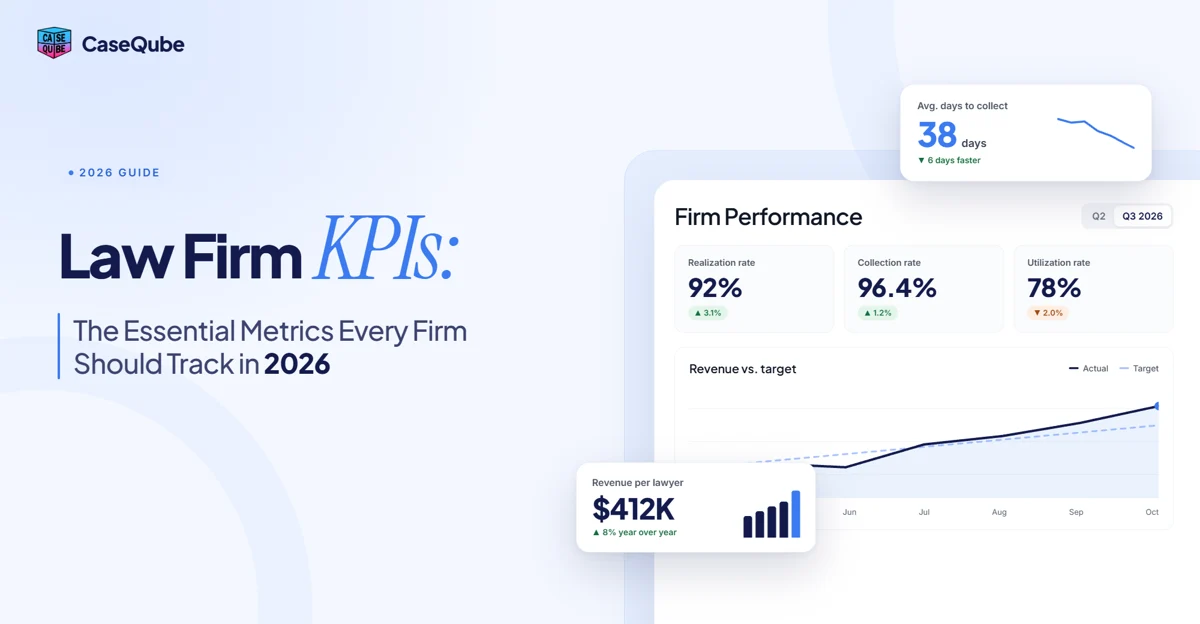
Revenue per Lawyer
This shows how much revenue each lawyer brings in on average.
Formula: Total revenue ÷ number of lawyers
Example: $1,800,000 ÷ 6 lawyers = $300,000 per lawyer
Profit Margin
This shows how much of your revenue you keep after all expenses. Revenue can grow while profit shrinks, so this is one of the most important numbers to watch.
Formula: (Net income ÷ total revenue) × 100
Example: ($450,000 ÷ $1,800,000) × 100 = 25%
Collection Rate
This is the share of billed fees that you actually collect.
Formula: (Fees collected ÷ fees billed) × 100
Example: ($162,000 ÷ $180,000) × 100 = 90%
A falling collection rate is often the first sign of a cash flow problem. Online payment options and sending invoices on time both help.
Accounts Receivable Days
This shows how long, on average, it takes clients to pay you.
Formula: Accounts receivable ÷ average daily billings
Example: $60,000 outstanding ÷ $3,000 billed per day = 20 days
Productivity KPIs for Hourly Billing
Utilization Rate
This shows how much of your lawyers' available time goes to billable work.
Formula: (Billable hours ÷ available hours) × 100
Example: (1,400 ÷ 2,000) × 100 = 70%
Realization Rate
This shows how much of the time recorded actually ends up on a bill. Time gets written off for many reasons: discounts, inefficient work, or entries the client won't pay for.
Formula: (Fees billed ÷ value of time recorded) × 100
Example: ($180,000 ÷ $200,000) × 100 = 90%
Utilization tells you whether your team is busy. Realization tells you whether that busy time turns into billable revenue. A firm can have high utilization and still lose money if realization is low.
Client and Growth KPIs
Client Acquisition Cost (CAC)
This is how much you spend to sign one new client.
Formula: Marketing and intake costs ÷ new clients signed
Example: $24,000 ÷ 40 new clients = $600 per client
Lead Conversion Rate
This shows how many inquiries become paying clients.
Formula: (New clients ÷ total leads) × 100
Example: (40 ÷ 200) × 100 = 20%
If conversion is low, look at how fast your team responds to leads, how intake calls are handled, and how quickly conflict checks are cleared.
Average Revenue per Client
Formula: Total revenue ÷ number of clients
Example: $1,800,000 ÷ 300 clients = $6,000 per client
Compare this with your client acquisition cost. If it costs $600 to sign a client worth $6,000, your marketing is paying off.
Client Referral Rate
This is the share of new clients who came from referrals by past clients or other lawyers. A rising referral rate usually means clients are happy with your work.
Case and Operations KPIs
Case Cycle Time
This is the average number of days from when a matter opens to when it closes. Track it by practice area and case type, since a contested divorce and an uncontested one won't have the same timeline. If cycle time keeps rising, look for where cases stall: waiting on records, waiting on approvals, or waiting on staff.
Matters Opened vs. Matters Closed
If your firm opens more matters than it closes month after month, caseloads grow until deadlines get missed. This KPI helps you see when to hire before your team is overloaded.
KPIs for Contingency Fee and Personal Injury Firms
Most law firm KPI guides are written for hourly billing. Contingency fee firms need different numbers, because they don't get paid until a case settles.
- Average settlement value: Total settlements ÷ number of cases settled. For example, $3,000,000 ÷ 40 cases = $75,000.
- Case costs per matter: The average amount your firm advances on each case for records, experts, and filing fees. Watch this against average fees earned per case.
- Time to settlement: The average days from signing the client to reaching a settlement. Long timelines tie up your firm's cash.
- Time to disbursement: The days between receiving settlement funds and paying the client. Long delays frustrate clients and can point to trust accounting problems. Our guide on how personal injury settlements are distributed explains each step.
Trust Accounting KPIs
Every firm that holds client money should track trust compliance, not just revenue.
- Monthly reconciliation completed on time: Was your three-way reconciliation finished, and did all three balances match?
- Unresolved trust differences: The number of items that didn't reconcile and how long they've stayed open. This number should always be zero by the end of the review.
Law Firm KPI Formulas: Quick Reference
| KPI | Formula |
|---|---|
| Revenue per lawyer | Total revenue ÷ number of lawyers |
| Profit margin | Net income ÷ revenue × 100 |
| Collection rate | Fees collected ÷ fees billed × 100 |
| Accounts receivable days | AR ÷ average daily billings |
| Utilization rate | Billable hours ÷ available hours × 100 |
| Realization rate | Fees billed ÷ value of time recorded × 100 |
| Client acquisition cost | Marketing and intake costs ÷ new clients |
| Lead conversion rate | New clients ÷ total leads × 100 |
| Average revenue per client | Total revenue ÷ number of clients |
| Average settlement value | Total settlements ÷ cases settled |
How Often to Review Law Firm KPIs
Not every KPI needs the same attention.
- Weekly: New leads, conversion rate, and matters opened. These are best watched by intake staff and practice managers.
- Monthly: Collection rate, accounts receivable, utilization, realization, and trust reconciliation. Partners and the finance team should review these.
- Quarterly: Profit margin, revenue per lawyer, client acquisition cost, case cycle time, and average settlement value. These show trends that a single month can hide.
Why Law Firm KPI Numbers Often Don't Match
Many firms track cases in one system, billing in another, and accounting in a third. Then someone exports reports from each and combines them in a spreadsheet. By the time the numbers are ready, they're out of date, and they rarely match. Revenue in the billing system doesn't line up with the books, and case counts depend on who ran the report.
Accurate KPIs depend on clean data. If time entries are missed, realization looks better than it is. If payments aren't recorded against the right matter, collection rate is off.
Tracking Law Firm KPIs Without Spreadsheets
The easiest way to get reliable KPIs is to keep your case, billing, and accounting data in one system. CaseQube does that. Matters, time and expenses, invoices, payments, and trust accounting all live in the same platform, and real-time dashboards show your cases, finances, and team workload without anyone building a report by hand. CaseQube also uses AI to flag time entries that look missing before you bill, which helps keep your realization numbers accurate.
Frequently Asked Questions
What are KPIs for a law firm?
Law firm KPIs are measurable numbers that show how your firm is performing against its goals. Common examples include collection rate, utilization rate, realization rate, profit margin, client acquisition cost, and case cycle time.
What are the most important KPIs for a law firm?
For most firms, the most important KPIs are collection rate, profit margin, realization rate, utilization rate, client acquisition cost, and accounts receivable days. Contingency firms should add average settlement value, case costs, and time to settlement.
What is the difference between utilization rate and realization rate?
Utilization rate shows how much of a lawyer's available time is spent on billable work. Realization rate shows how much of that recorded time actually gets billed. One measures how busy your team is, and the other measures how much of that work turns into revenue.
How do you calculate collection rate for a law firm?
Divide the fees collected by the fees billed for the same period, then multiply by 100. If you billed $180,000 and collected $162,000, your collection rate is 90%.
What is a good profit margin for a law firm?
It depends on firm size, practice area, and how the firm pays its partners. Figures quoted for small firms often fall between 20% and 40%. The most useful comparison is against your own firm's past results, so you can see whether margin is improving.
How often should a law firm review its KPIs?
Review lead and intake KPIs weekly, financial and productivity KPIs monthly, and profitability and growth KPIs quarterly. Trust reconciliation should be completed and reviewed every month.
What KPIs should a small law firm track?
Start with five: collection rate, accounts receivable days, utilization rate, lead conversion rate, and profit margin. These show whether you're getting paid, staying busy, winning new work, and making money. Add more once these are part of your monthly routine.
What KPIs should contingency fee or personal injury firms track?
Track average settlement value, average fee per case, case costs per matter, time to settlement, time to disbursement, and lead conversion rate. These show which cases are worth taking and how quickly your firm turns cases into cash.
How do you track law firm KPIs without spreadsheets?
Use practice management software that keeps cases, billing, payments, and accounting in one system and has built-in dashboards. That way, KPIs update as your team works instead of being rebuilt from exports every month.
Why don't my law firm's KPI numbers match across systems?
Usually because case, billing, and accounting data live in separate systems that don't sync. Payments get recorded in one place but not another, or time entries are missed. Keeping all of this data in one system is the most reliable fix.
Final Thoughts
The best law firm KPIs are the ones you'll actually review and act on. Start with a short list that fits how your firm bills: collection rate, profit margin, and accounts receivable for every firm, utilization and realization for hourly work, and settlement value and case timelines for contingency work. Set a review routine, assign each KPI to someone, and make sure the data behind it is accurate.
To see your firm's cases, billing, and trust accounting in one real-time dashboard, schedule a CaseQube demo.
Ready to simplify your case management?
See how CaseQube keeps every matter, document, and deadline in one place.
Book a DemoRelated posts
Personal Injury Demand Letter: Strategies and Tips for Writing One That Gets Results
 Ramit KaurOctober 21, 2026

Best Personal Injury Practice Management Software for 2026
Ramit KaurOctober 21, 2026
Client Intake Best Practices for Mid-Size Law Firms in 2026
Mid-size firms rarely lose leads from lack of effort. They lose them to too many front doors and no single owner. Here is what to measure and what to change.
Ramit KaurOctober 13, 2026 · 7 min read