
Client Intake Best Practices for Mid-Size Law Firms in 2026
Mid-size firms rarely lose leads from lack of effort. They lose them to too many front doors and no single owner. Here is what to measure and what to change.

On this page
A prospective client fills out your contact form at 7:15 on a Friday evening. Where does it go?
At a solo practice, the answer is usually the attorney's phone. At a firm with 40 lawyers, three practice groups, and two offices, it's harder to say. It might reach an intake coordinator Monday morning. It might sit in a shared inbox nobody owns.
Hennessey Digital's 2025 study of 1,333 law firms found that 26% never respond to an online lead at all. The median response time was 13 minutes, but only a quarter of firms replied within five. Clio's secret shopper study of 500 firms found 40% answered the phone when a prospective client called.
26%
of law firms never respond to an online lead
13 min
median response time to online leads
40%
of firms answered the phone for a prospective client
You already paid to generate that lead. This covers what intake actually involves, why it breaks differently at mid-size firms, and what to change.
What is legal intake?
Legal intake is everything between first contact and an open matter. The inquiry arrives, someone qualifies it, a conflict check runs, a consultation happens, a fee agreement gets signed, and the file opens.
Most firms manage the first half of that well and treat the second half as paperwork. It's the wrong way round. The first half decides whether you win the client. The second half decides how much it costs to serve them and whether the matter starts with clean data or with three weeks of chasing.
Why intake breaks differently at mid-size firms
Solo practices have an intake problem of volume. Mid-size firms have one of structure.
There is more than one front door. A main line, a web form, a chat widget, referral calls that go straight to a partner's cell, and a second office with its own number. Each one behaves differently, and most firms have never mapped them.
There are handoffs. Reception takes the call, an intake coordinator qualifies it, an attorney decides whether to take it. Every handoff is a place the lead can stall, and no single person can see the whole path.
Conflicts get genuinely hard. Under ABA Model Rule 1.10, one lawyer's conflict is imputed to the entire firm. A manual check against a spreadsheet works at six attorneys. At sixty, across multiple practice groups and years of former clients, it stops being reliable.
Nobody owns it. At a solo firm intake is obviously the attorney's job. At 50 attorneys it belongs partly to marketing, partly to reception, and partly to whoever the matter eventually lands with. Work that belongs to everyone gets done by nobody.
Client intake best practices
Measure before you change anything. Track three numbers for a month: median first response time, the share of inquiries that get any response at all, and how many inquiries become signed clients. Measure phone and web separately, because they fail for different reasons. Most firms discover their real numbers are worse than they assumed.
Run the conflict check at first contact. Most firms run it at engagement, days after the first conversation. By then an attorney has spent an hour on a consultation and the prospect has shared confidential information. Running the check when the inquiry arrives costs nothing and occasionally saves the firm from a disqualification motion.
Build separate forms for each practice area. A generic contact form gets you a name and a sentence. A personal injury form should ask for the date of the accident, the treating providers, and whether the insurer has already made contact. A family law form asks entirely different questions. The right questions up front mean an attorney can evaluate the matter in one read instead of three phone calls.
Ask for documents while the client is still filling out the form. The police report, the insurance card, the ID, the prior agreement. Requesting these at intake takes one line on a form. Chasing them three weeks later takes four emails and a phone call, and it delays the work.
Plan for after hours. Roughly 42% of legal inquiries arrive outside 9 to 5, according to Ruby Receptionists. Legal problems happen on weekends. This is the one part of intake software doesn't solve on its own, and it takes a staffing decision: an answering service, a rotating on-call coordinator, or an intake team with staggered hours.
Stop entering the same information twice. This is the one most firms skip. A client gives you their details at intake. Someone retypes them into the case management system. Someone else retypes them into the billing system. Every re-entry costs time and introduces a chance for the number to be wrong, and the error usually surfaces at invoicing.
How to tell whether your intake is working
Three numbers tell you most of what you need.
Median first response time, tracked separately for phone and web. Response rate, meaning the share of inquiries that receive any reply. If that's below 90%, fix it before touching anything else. Inquiry-to-signed-client rate, which sits around 14 to 17% across the industry, so you have a benchmark.
Track these monthly. Intake drifts, especially after staff turnover, and it drifts quietly.
CaseQube
Where CaseQube fits
CaseQube's Smart Intake handles the part of this that software can actually fix.
Forms are built per practice area or case type, so a PI inquiry and an immigration inquiry ask different questions. Conflict checks run automatically at form submission rather than at engagement. Documents can be requested at intake, so IDs and supporting files arrive with the inquiry. Submissions trigger case tasks, and the form becomes an open matter with mapped fields, which means nobody retypes the client's information into the case file or the billing system.
That last part matters most at mid-size firms, because CaseQube runs case management, document management, and accounting in the same platform. The data entered once at intake is the same data on the invoice.
Most firms go live in under 30 days.
CaseQube doesn't answer your phone. Response speed is still a staffing question. What it removes is the delay and the retyping that happen after the inquiry lands.
Bottom line
Mid-size firms rarely have an intake problem caused by lack of effort. They have one caused by having six ways in and no single owner.
Start by measuring. Move the conflict check to first contact. Ask better questions on the form, and ask for the documents while you have the client's attention. Then make sure the information collected at intake never has to be typed again.
Schedule a demo to see how Smart Intake handles your practice areas.
Ready to simplify your case management?
See how CaseQube keeps every matter, document, and deadline in one place.
Book a DemoRelated posts
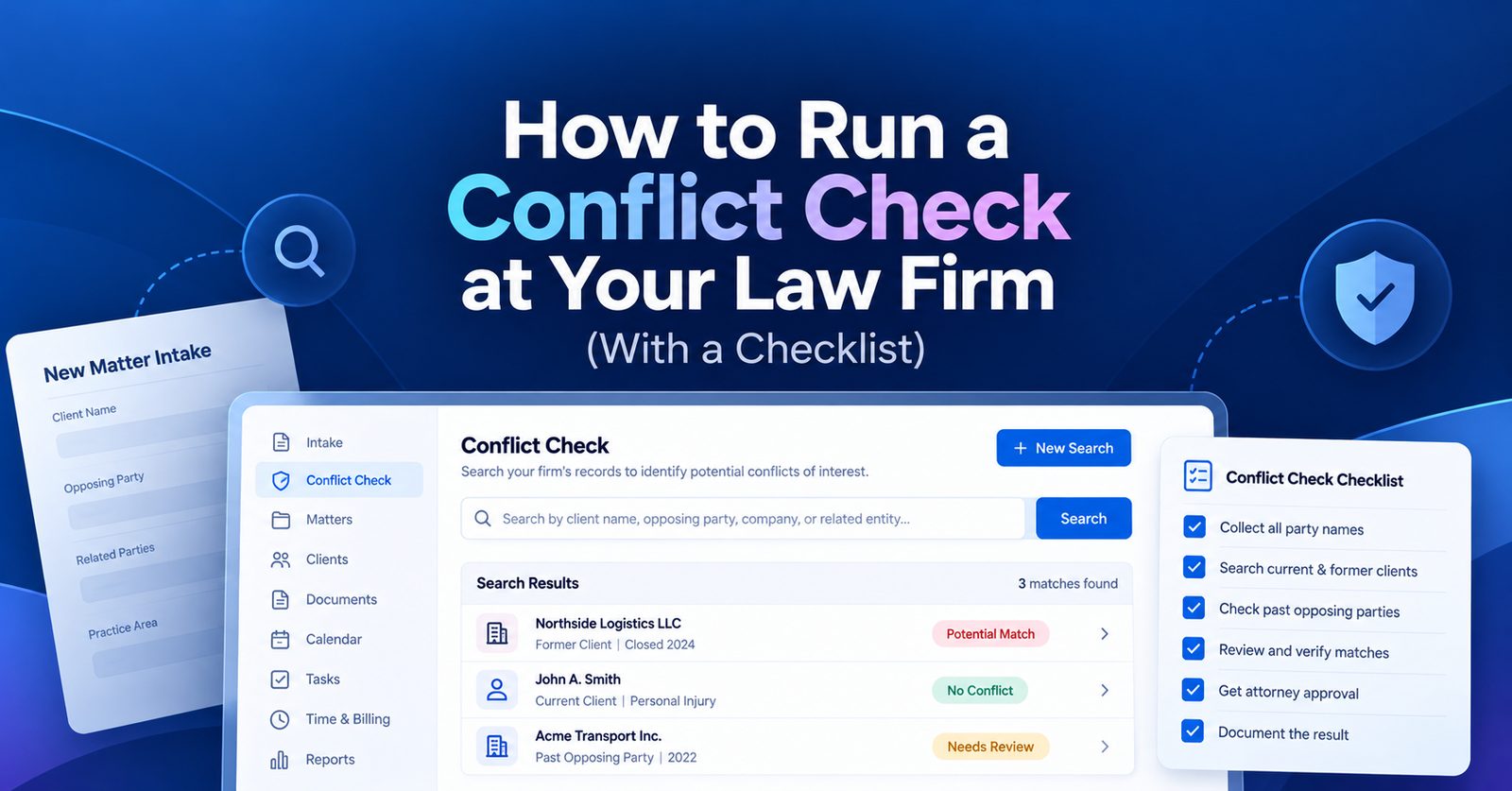
How to Run a Conflict Check at Your Law Firm (With a Checklist)
A step-by-step guide to running a conflict check at your law firm, from collecting names at intake to documenting the decision, plus a checklist your team can use on every new matter.
 Ramit KaurOctober 13, 2026 · 9 min read
How Personal Injury Settlements Are Distributed: A Step-by-Step Guide for Law Firms
A step-by-step guide to the settlement disbursement process, from the trust deposit and lien payoffs to the settlement statement and final payout, with a worked example.
Ramit KaurOctober 13, 2026 · 7 min read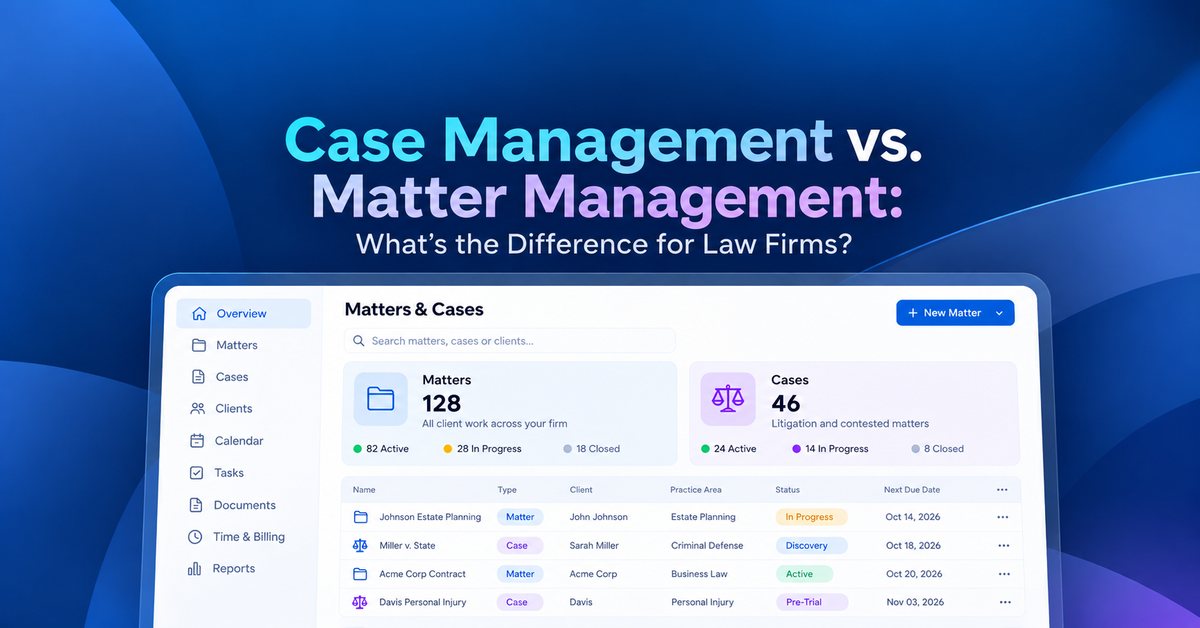
Case Management vs. Matter Management: What's the Difference for Law Firms?
Every case is a matter, but not every matter is a case. A plain guide to what each term means for a law firm, how they compare, and which one your firm needs.
Ramit KaurOctober 13, 2026 · 8 min read