
Case Management vs. Matter Management: What's the Difference for Law Firms?
Every case is a matter, but not every matter is a case. A plain guide to what each term means for a law firm, how they compare, and which one your firm needs.
On this page
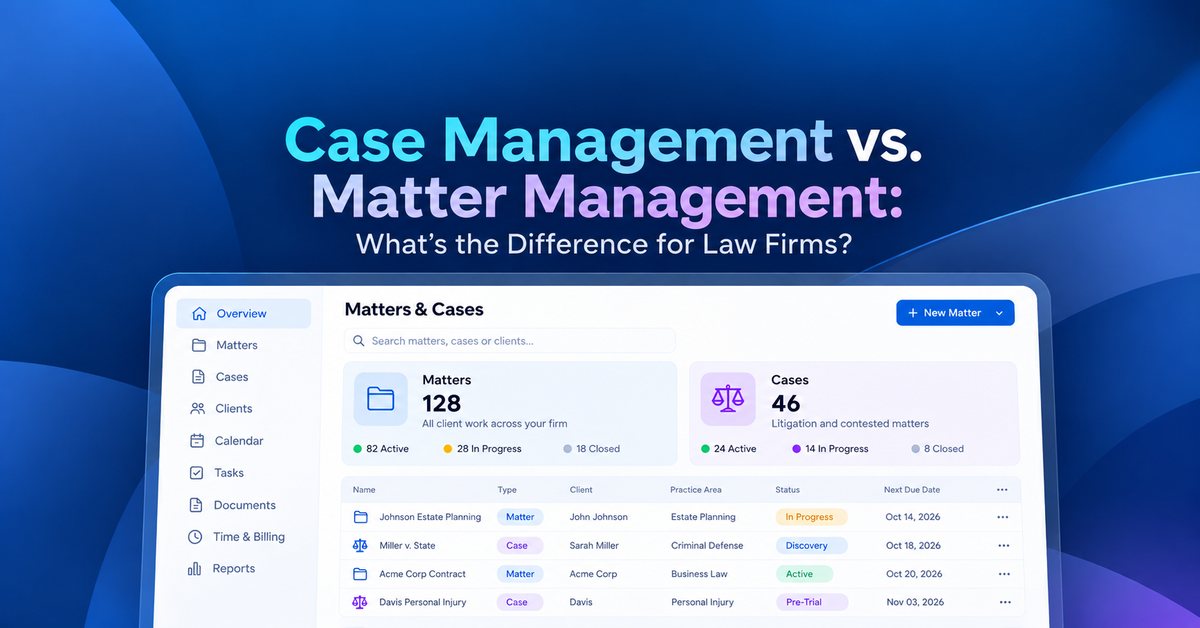
Case management and matter management overlap, but they are not the same thing. A matter is any piece of legal work a firm does for a client. A case is a matter that involves a dispute, usually with a court, an opposing party, or an insurer. So every case is a matter, but not every matter is a case. Matter management is how a firm runs all of its client work. Case management is how it runs a dispute from intake to outcome.
The two terms get mixed up because software vendors, bar resources, and in-house legal teams all use them differently. Below is what each one means for a law firm, how they compare, and which one your firm actually needs.
Why the terms get confused
You will see two different explanations online.
The first comes from in-house legal departments. In that world, "matter management" means tracking all the legal work inside a company: contracts, compliance questions, employment issues, and the litigation handed to outside counsel. "Case management" is described as something law firms do.
The second comes from law firms. Here, matter management is the firm-wide view, and case management is the work on a single case.
Both explanations are fair in their own setting. For a law firm, the second one is the useful one, and the clearest way to see it is to look at the work itself.
What is a matter?
A matter is any piece of legal work you open a file for. It has a client, a responsible attorney, a scope of work, and usually its own billing. Some examples:
- Drafting a will or setting up a trust
- Forming an LLC
- Reviewing a commercial lease
- Handling a real estate closing
- Filing a trademark application
- Defending a client in a car accident lawsuit
All six are matters. Only the last one is a case.
What is matter management?
Matter management is how a firm organizes and tracks all of its matters, across every practice area and every attorney. It answers firm-level questions:
- How many matters are open right now, and who owns each one?
- Which matters are stuck, and at what stage?
- How much time has been recorded and billed on each matter?
- Which practice areas bring in the most revenue?
- Are conflict checks done before a new matter opens?
Day to day, matter management covers intake, conflict checks, assigning work, tracking each matter's status, storing documents, recording time and expenses, billing, and reporting. It is how firm owners and practice leaders see the whole firm in one place.
What is case management?
Case management is the work of moving a single dispute from intake to resolution. It applies to litigation and other contested work, such as personal injury, family law, insurance defense, workers' compensation, criminal defense, and bankruptcy.
Case management focuses on things that a will or an LLC formation never has:
- Court dates, filing deadlines, and statutes of limitation
- Pleadings, discovery, and evidence
- Opposing counsel, adjusters, witnesses, and experts
- Settlement negotiations and trial preparation
- Medical records and liens in injury cases
If a deadline is missed in a case, the client can lose the claim. That is why case management puts so much weight on calendars, task lists, and stage-by-stage workflows.
Case management vs. matter management at a glance
| Matter management | Case management | |
|---|---|---|
| Scope | All client work across the firm | A single dispute |
| Applies to | Every practice area, including transactional work | Litigation and contested matters |
| Main questions | What is open, who owns it, how is it billing? | What is due next, and where does the case stand? |
| Key tools | Intake, conflict checks, time, billing, reporting | Court calendars, deadlines, discovery, case stages |
| Main users | Firm owners, practice leaders, operations staff | Attorneys, paralegals, case managers |
| Success looks like | Firm-wide visibility and steady cash flow | A strong outcome for the client, on time |
Does your law firm need case management, matter management, or both?
It depends on the kind of work you do.
Mostly transactional firms need matter management. Estate planning, business, and real estate firms work in matters with clear steps and deadlines, but there is no court calendar or discovery to manage.
Mostly litigation firms need strong case management. A personal injury or insurance defense firm lives on deadlines, documents, and case stages. They still need matter management for intake, billing, and reporting across all their cases.
Mixed-practice firms need both. A general practice firm might have a divorce, a will, and a contract dispute open for the same client. Each needs to be tracked as a matter, and the contested ones also need case tools.
In practice, most firms do not want two separate systems. The firm-level view is only as accurate as the case-level data underneath it. If deadlines and documents live in one tool and billing lives in another, someone ends up entering the same information twice.
What to look for in law firm software
Whatever you call it, look for software that handles both levels in one place:
- Intake and conflict checks that create a new matter from the intake form
- Matter stages that trigger the right tasks, deadlines, and document templates as work moves forward
- Court and deadline calendaring that syncs with your team's calendars
- Document management with search and access controls by matter
- Time and expense tracking tied to each matter
- Billing and trust accounting that pull from the same matter records
- Reports and dashboards for open matters, workload, and revenue by practice area
How CaseQube handles both
CaseQube is built as both matter management and case management software for law firms. Intake and conflict checks open the matter. Each matter stage can trigger its own deadlines, checklists, and document templates, so a lease review and a personal injury case each follow their own workflow. Time, billing, payments, and trust accounting run in the same system, so the firm-wide reports come from the same data your team works in every day.
Frequently asked questions
What is the difference between case management and matter management?
Matter management covers all of a firm's client work across every practice area. Case management covers the handling of a single dispute, such as a lawsuit or an injury claim, from intake to resolution. Every case is a matter, but not every matter is a case.
Are case management and matter management the same thing?
No, though many people use the terms interchangeably. Case management is a part of matter management that focuses on contested work with court dates, opposing parties, and discovery.
What is a matter in a law firm?
A matter is any piece of legal work a firm opens a file for, such as drafting a will, forming a company, closing a real estate deal, or handling a lawsuit. Each matter has a client, a responsible attorney, and usually its own billing.
Is every legal matter a case?
No. A case involves a dispute, usually with a court or an opposing party. Transactional work like contracts, estate planning, and business formation is a matter but not a case.
Do law firms use matter management or case management?
Most law firms use both. Matter management gives firm leaders a view of all open work and billing. Case management helps attorneys and paralegals run litigation and other contested work.
Is matter management only for in-house legal teams?
No. In-house legal departments use the term often, but law firms also manage matters. For a firm, matter management means tracking every client engagement, from intake to billing.
Does my firm need separate case management and matter management software?
Usually not. Most firms are better served by one system that handles both, so deadlines, documents, time, and billing stay connected to the same matter record.
What features should law firm case management software have?
Look for intake and conflict checks, deadline and court calendaring, matter stages with task workflows, document management, time and expense tracking, billing, trust accounting, and reporting.
Is practice management software the same as case management software?
They overlap heavily. Practice management software usually covers the business side of the firm, such as billing, accounting, and reporting, along with case and matter management. Many products sold under either name include both.
Which practice areas rely most on case management?
Litigation-heavy practice areas rely on it most, including personal injury, insurance defense, workers' compensation, family law, criminal defense, immigration, and bankruptcy.
Ready to simplify your case management?
See how CaseQube keeps every matter, document, and deadline in one place.
Book a DemoRelated posts

How Personal Injury Settlements Are Distributed: A Step-by-Step Guide for Law Firms
A step-by-step guide to the settlement disbursement process, from the trust deposit and lien payoffs to the settlement statement and final payout, with a worked example.
 Ramit KaurOctober 13, 2026 · 7 min read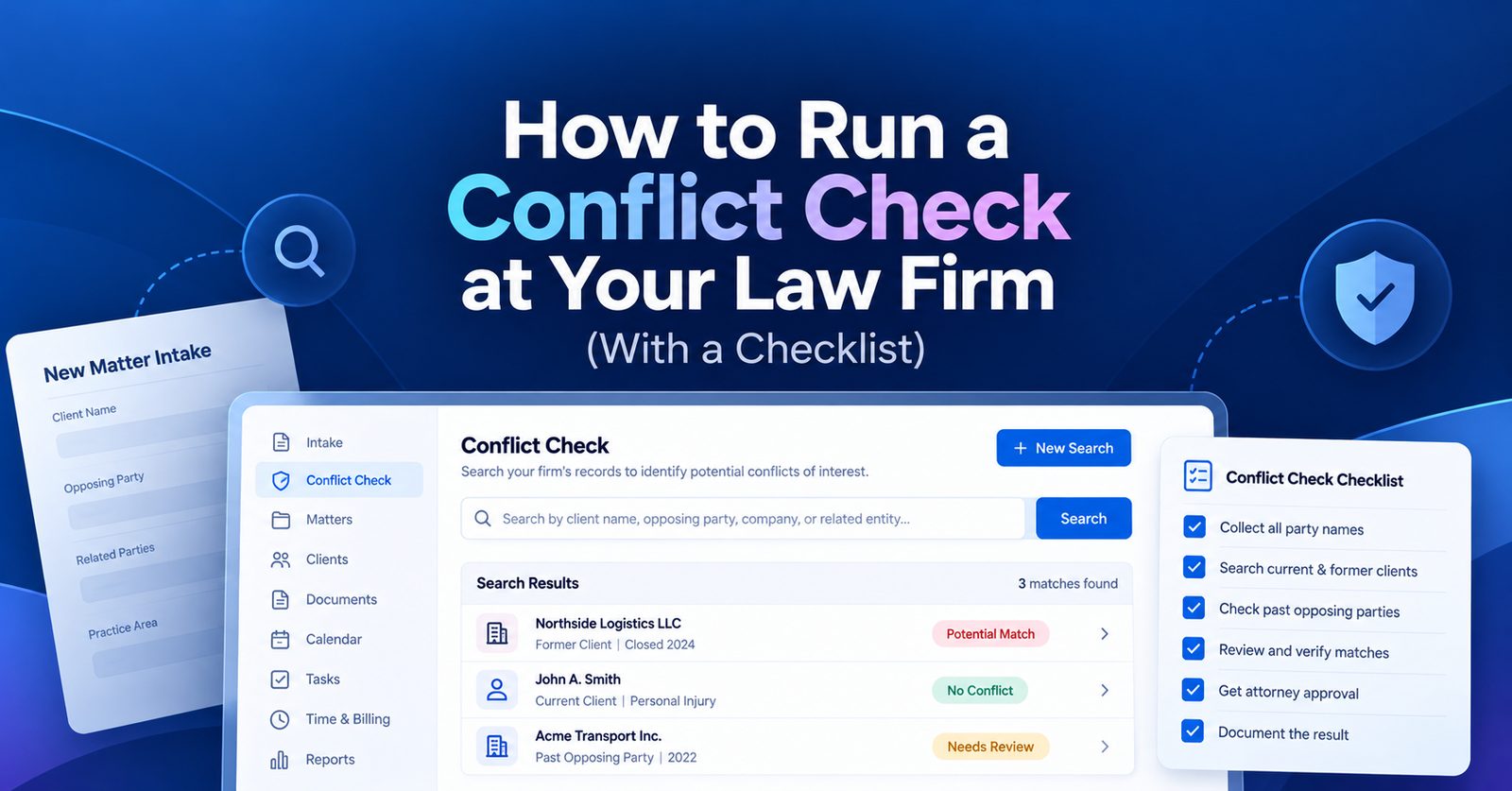
How to Run a Conflict Check at Your Law Firm (With a Checklist)
A step-by-step guide to running a conflict check at your law firm, from collecting names at intake to documenting the decision, plus a checklist your team can use on every new matter.
Ramit KaurOctober 13, 2026 · 9 min read
Client Intake Best Practices for Mid-Size Law Firms in 2026
Mid-size firms rarely lose leads from lack of effort. They lose them to too many front doors and no single owner. Here is what to measure and what to change.
Ramit KaurOctober 13, 2026 · 7 min read